Multi-Agent Translation Team (MATT) - Published
Enhancing Low-Resource Language Translation through Multi-Agent Translation Team (MATT)
📌 Abstract
Large language models (LLMs) benefit from revision and refinement, much like human collaborators in complex tasks requiring critical thinking. This paper introduces Multi-Agent Translation Team (MATT)—a sophisticated, iterative multi-agent workflow that refines English-to-low-resource language translations. Leveraging LLMs, Google Translate (GT), and role-based agents, MATT systematically enhances translation accuracy for Vietnamese, Hindi, and Malayalam.
This study presents a pioneering approach that outperforms baseline models by integrating evaluation coordinators, proofreaders, editors, and iterative loss minimization strategies. The results highlight MATT’s ability to deliver improved fluency, accuracy, and contextual adaptation compared to conventional machine translation models.
📖 Introduction
Language serves as a fundamental cultural bridge, yet the majority of online content remains inaccessible to non-English speakers. Machine translation tools such as Google Translate (GT) have made strides, but they struggle with low-resource languages, where linguistic nuances and contextual subtleties are harder to encode.
🌍 Why This Matters
- Only 15% of the world speaks English, leaving vast knowledge inaccessible.
- Countries like Vietnam and India, with growing foreign investments, face communication barriers due to limited English proficiency.
- In medical, legal, and research domains, poor translation can lead to significant consequences.
MATT addresses these challenges by integrating multi-agent workflows, ensuring translations maintain semantic integrity, fluency, and cultural appropriateness.
🚀 The MATT Architecture
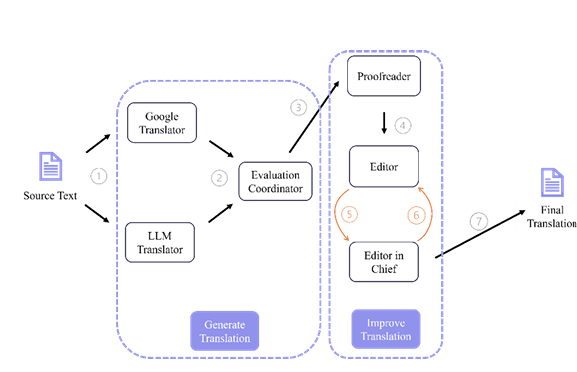
MATT refines translation in a two-layered process:
- Initial Translation Generation: Utilizes Llama 3.1 and Google Translate API.
- Iterative Translation Refinement: Involves proofreading, editing, and loss assessment by LLM-powered agents.
Key Components:
- Evaluation Coordinator – selects the most reliable base translation.
- Proofreader & Editor – refine fluency, accuracy, style, and terminology.
- Editor-in-Chief – quantifies Loss in Translation (LiT) and ensures quality control.
📊 Results & Performance Analysis
| Model | Vietnamese | Hindi | Malayalam |
|---|---|---|---|
| Baseline | 0.2471 | 0.1390 | 0.0158 |
| MATT | 0.2952 | 0.1681 | 0.0231 |
| Google Translate | 0.3886 | 0.2548 | 0.0728 |
- MATT outperforms the baseline consistently across all languages.
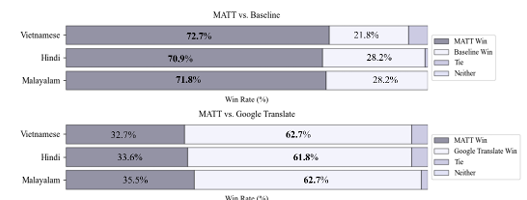
- Human evaluations favor MATT over both GT and baseline models in fluency and contextual adaptation.
📌 Key Takeaways
- MATT significantly improves translation quality by leveraging structured multi-agent collaboration.
- GT remains stronger in high-resource settings, but MATT surpasses it in nuanced, low-resource translations.
- Human preference aligns with MATT, while BLEU scores favor GT due to direct word-to-word comparisons.
🚧 Limitations
- Computational cost and API dependencies can increase processing time.
- LLMs may exhibit inconsistencies, requiring improved prompt engineering.
- Some languages still require more training data for significant gains.
📌 Conclusion
MATT represents a significant leap forward in low-resource language translation, demonstrating how multi-agent systems can enhance LLM-based translation workflows. By combining structured evaluation, iteration, and refinement, MATT provides a robust alternative to traditional MT models, achieving improved accuracy, fluency, and contextual integrity.
View the full publication on SMU Scholar.